

Guitar Pedals & Effects
The first guitar effects pedals were studio units developed in the 1940s, but it wasn't until the 1960s, and the widespread availability of transistors, that guitar pedals would begin to take the shape we know today.
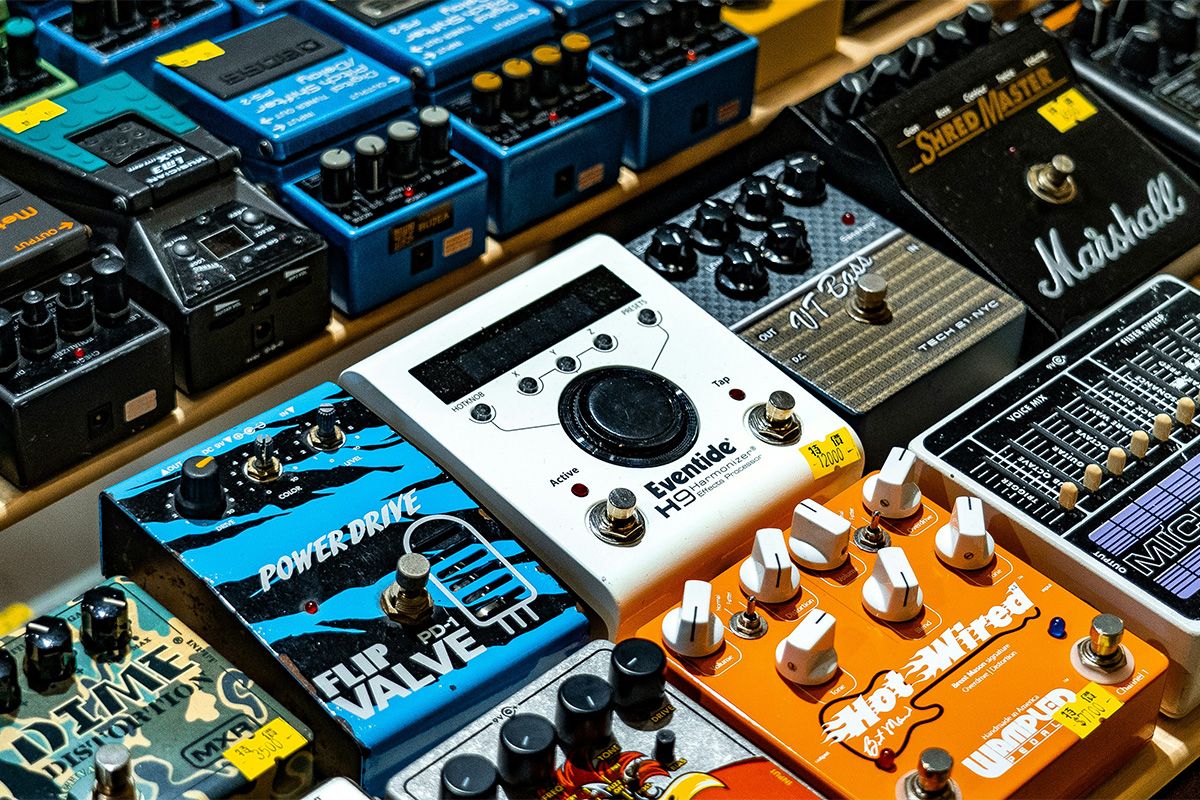
Whether you're a beginner building your first pedalboard or a seasoned pro looking for that next boutique effect to add to your collection, we have a range in-store and online that'll help you mould a unique sound. With distortion, fuzz, chorus, flangers, phasers, reverbs, delays and loopers from brands like Boss, Electro-Harmonix, Strymon and many more, we can help fill the floor at your feet with tonal goodness. And if you're not sure where to start, we're here to help! In-person, over the phone, or even online with our guitar pedals and effects explained article.
- $ Min$ Max
Finding Your Sound
Edgy, sludgy, washed out, jangly, ethereal, raw, organic. When it comes to tone, guitars don't do all the work. Chances are your favourite sound has been created using effects pedals. Guitar pedals sit between your sound source (guitar or bass) and your amp, shaping your tone before it reaches the speaker. Delay and reverb add depth and space to your sound; distortion pedals add grit by clipping your audio; dynamic effects like compressors control your volume and sustain; while modulation pedals affect the pitch.
Effects Pedal Types
Analog Pedals vs Digital
Outside of effect type, a big decision for most buyers is the choice between analogue and digital. Analogue does what it says on the tin. Your signal passes purely through electronic components, giving a warm, natural sound. Digital effects use onboard processors and studio-grade algorithms to unlock deeper editing, presets, and effects.
From here, let's run through the main pedal families and what each one actually does to your sound.
Boost, Overdrive, Distortion & Fuzz
For all tones crunchy and heavy. These pedals work by pushing your signal to the very brink and beyond. Boosters are great for giving your sound an extra bit of gain to really start feeling the saturation of a tube amp or cutting through the mix in a solo. Overdrive simulates the natural amp break up without cranking your amp to an overbearing level. Distortion is the natural next step, clipping your sound for that high gain crunch. Fuzz, on the other hand, uses germanium or silicon transistors to generate the fuzzy, harmonic and compressed sound that defines 60s and 70s psych and garage rock. Consider where a pedal sits in your signal chain, before or after the amp's own gain stage changes the result significantly.
Delay & Reverb
Take your guitar and amp to the bottom of the Grand Canyon and let rip. Better yet, save yourself the airfares and get yourself a reverb or delay pedal. These pedals create space and mimic reflections and echoes. Delay pedals work by repeating your signal at set intervals, whilst reverb pedals simulate acoustic spaces. Both effects come in a few flavours worth knowing. Reverb pedals typically offer spring (the bouncy, surf-rock classic), hall (big, cavernous, orchestral), and plate (smooth and dense, a studio staple); each simulating a different physical space. Delay pedals range from analog/tape-style, which warm and degrade each repeat for a vintage, lo-fi feel, to digital delay, which keeps every repeat pristine and clear, right through to more experimental modes like reverse or ping-pong delay that bounce the signal between speakers. Most modern pedals give you a mix-and-match of these modes in one box, so you're not stuck picking just one.
Many players run delay before reverb in the chain so echoes decay into the reverb tail rather than the reverse.
Loopers
A looper records a phrase in real time and plays it back on a continuous loop, letting you build multi-layered arrangements without a backing band. Entry-level single-loop pedals (like the Boss RC-1) suit practice and simple live layering with one record/overdub/stop footswitch. Multi-track loopers add independent loop channels, overdub and undo/redo, and onboard effects, useful for building full song structures live. Look at maximum loop length, whether overdubs are unlimited, and if the unit supports quantised looping (auto-syncing new layers to the existing tempo) - a key feature for tight, rhythmically accurate layering.
Wah, Filter, EQ & Compression
These pedals shape dynamics and frequency rather than adding harmonic distortion. A wah pedal uses a treadle-controlled bandpass filter to sweep a vocal-like resonant peak across the frequency spectrum for the classic funk and rock effect. Envelope filters (auto-wah) achieve a similar sweep automatically, triggered by your picking dynamics rather than a treadle. EQ pedals let you boost or cut specific frequency bands to correct an amp's tone or carve space in a mix, typically via graphic (fixed bands) or parametric (adjustable) controls. Compressors even out dynamic range, raising quiet notes and taming loud ones for smoother sustain. This is especially valuable for clean funk and country picking, and for smoothing out uneven pick attack.
How Do I Create a Certain Sound?
Want to sound like Hendrix? Pick up a Fuzz Face and a wah pedal. Chasing some surf rock vibes? Spring reverb and tremolo are the way to go. After a shiny, studio-polished yacht rock sound? Maybe some chorus and compression. There's no right or wrong way to build your pedalboard.
The easiest way is to work backwards from a song or artist you love. Pull up a rig rundown or gear list for your favourite guitarist and you'll usually spot a pattern: two or three core pedals doing most of the work, not a wall of forty. Start there, get those sounding right, then start swapping and stacking to make it your own. Your pedalboard should tell the story of how you actually play, not someone else's.
Pedals are personal, so try before you buy. Our demo rooms across all stores let you plug in and hear the difference for yourself, no pressure, no rush. Order online and pick up in as little as 2 hours with Click & Collect, or have it shipped free on orders over $100.
Guitar Pedal FAQs
Are guitar pedals worth it?
Yes, if you want more control over your tone than your amp alone provides. Even one well-chosen pedal can transform your sound.
Can I use guitar pedals for bass?
Some work fine, but bass-specific pedals handle low end better and avoid muddiness.
Do I need a power supply?
Once you have more than one or two pedals, yes. It's cleaner and quieter than daisy-chaining batteries.
What pedal should I buy first?
A tuner! But if you’ve got one of those, start with an overdrive or reverb. They solve the most common tone problems and suit almost any genre.
What order should I put my pedals in?
There's no single rule, but a common starting chain is: dynamics/filter (wah, compressor) → gain (boost, overdrive, distortion, fuzz) → modulation (chorus, phaser, flanger) → time-based (delay, reverb). Play with it — the "wrong" order sometimes sounds the best.
Do I need an effects pedal if I already have amp modelling built in?
Onboard amp effects are a great starting point, but standalone pedals usually give you more hands-on control and a wider range of tones to combine.
Want to read more? Check out our article on audio effect types and their uses, and you might want to learn a little bit about guitar modding. You can also give us a call and chat to a guitar expert if you'd like to talk it over, we're always happy to help!
Need Help Choosing Your Next Effect?
Compression, reverb, fuzz, delay — there's a lot of ground to cover. Our guide to audio effect types breaks down every major category: what each effect does, when to use it, and how to get the most out of it. Whether you're building your first pedalboard or just want to understand your signal chain better, it's a good place to start.